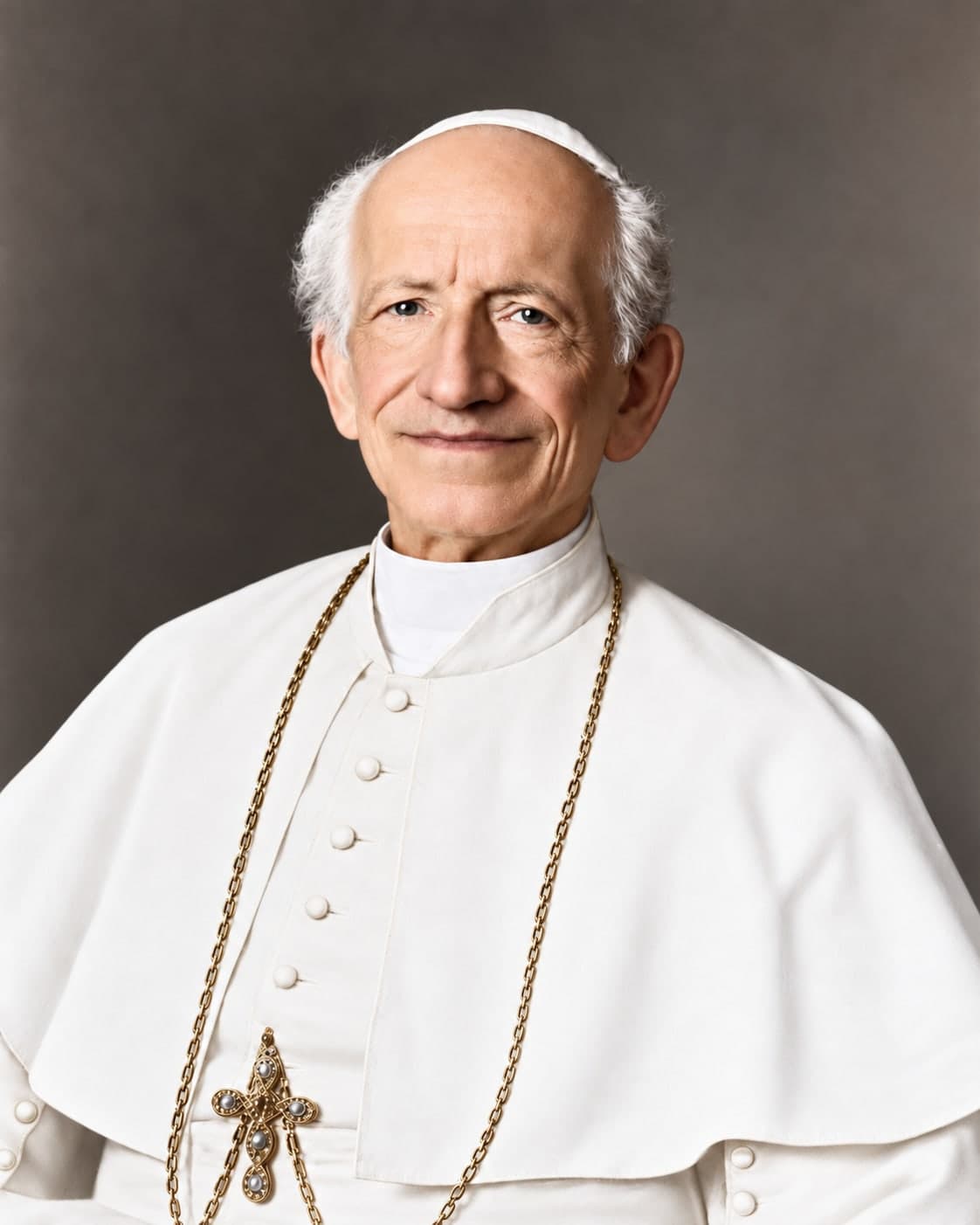
Pope Leo XIII · c. 1898
From Warmeriville to Rome
Léon Harmel was neither a theorist nor a politician. But through his books, his congresses and his pilgrimages, this provincial mill owner left his mark on the Church of his time.
The books of an employer
In 1877, Mame of Tours published the Manuel d'une corporation chrétienne (Handbook of a Christian Corporation). In it, Harmel described Val-des-Bois and drew a method from it. The second edition, in 1879, was the one that truly circulated and made the experiment known throughout Catholic Europe. In it we read the source of his commitment:
In his eyes the workers are not common men, weak and fickle. They are souls redeemed by the blood of Jesus Christ.
In January 1889, he published the Catéchisme du patron (Employer's Catechism), “drawn up with the help of a great many theologians”. In question-and-answer form, it sets out the duties of the head of a business: a just wage, respect for rest, the dignity of the worker, the role of associations. Most of these themes would be taken up two years later by Rerum Novarum.
These were followed by brochures on the Val (1890, 1895, 1897), the review Annales de Notre-Dame de l'Usine (from 1886), and in 1903 La Démocratie dans l'usine (Democracy in the Factory), a lecture given in Rome, which contains his most famous motto.
His books, speeches and letters, together with accounts by his contemporaries, can be read in full on the Texts page, re-edited as PDFs from the originals.
The Workers' Circles
In the aftermath of the Commune, Albert de Mun and René de La Tour du Pin founded the Œuvre des cercles catholiques d'ouvriers (Catholic Workers' Circles): places where workers and the “ruling class” could meet around their faith. Harmel joined them in 1873 and took part in their congresses.
Val-des-Bois became the movement's showcase: what others described, Harmel put into practice. But their paths diverged. De Mun and La Tour du Pin dreamed of Ancien Régime-style corporations; Harmel, in close contact with his workers, turned towards democracy. He withdrew from the movement's council of studies in 1882, and the break with de Mun was complete in 1892.
France du Travail in Rome
The idea was Léon Harmel's, and it was new: to bring to the pope not delegations of notables, but workers and employers together. This would be “La France du Travail à Rome” (Labour France in Rome). It meant organising the journey, lodging and funding for thousands of people.
October 1889
≈ 10,000
workers, employers and priests
The largest gathering: nearly ten thousand pilgrims of the “France du Travail” (Labour France). Leo XIII confided to Harmel: “it is through them [the workers] that the good cause can be made to triumph”.
Rerum Novarum “of new things”
On 15 May 1891, Leo XIII published the encyclical Rerum Novarum, “of new things”: the Church's first major statement on the condition of the workers. It condemned both socialism and unbridled liberalism, and defended a just wage, the right of association, rest and the protection of the weak.
Harmel was not its author, but he had prepared the ground. Cardinal Langénieux was authorised to present it as “the reward of the workers' pilgrimages”. And the pope is credited with these words about Harmel: “This dear son has given me the best days of my pontificate.”
Forty years later, Pius XI's encyclical Quadragesimo anno (1931) enshrined three of the Val's insights without naming Harmel: a wage that takes family responsibilities into account, the principle of subsidiarity, and the idea of tempering the wage contract with elements of a partnership contract.
Christian democracy
From 1888, Harmel stepped beyond the mill. He launched La Croix de Reims, in 1889 led an election campaign in Reims “for Jesus Christ”, without standing as a candidate himself, and in 1891 founded an association of Christian employers, the Union fraternelle du commerce et de l'industrie (Fraternal Union of Commerce and Industry). On 8 January 1890, he adopted a motto: “Christ and Liberty”.
In 1893 and 1894, he convened Christian workers' congresses in Reims; in 1896, he spoke at the national congress of Christian democracy in Lyon. This commitment earned him opponents within the Church itself: the Catholic employers of the Nord, attached to mixed unions, and Bishop Turinaz of Nancy, who in 1902 wrote Périls de la foi (Perils of the Faith).
Whatever is not of the people does not seem to me worth our efforts: that is my particular passion.
“We must declare ourselves clearly republican, clearly democratic and clearly Christian, in order to serve God, the People and the Fatherland.”
The Val, a training school
Harmel was convinced that people had to be trained. In 1885, he helped to found an industrial school at the Catholic Faculties of Lille, which has since become an engineering school. Above all, from the late 1880s until the early 20th century, he opened Val-des-Bois every summer to social study sessions for seminarians and young priests, who discovered the mill from the inside.
Among those who came were Marc Sangnier, who would found the Sillon, and the Belgian Paul Tschoffen; around 1907, the young Abbé Joseph Cardijn, future founder of the Young Christian Workers. The formula foreshadowed the Semaines sociales de France (Social Weeks), the first of which was held in Lyon in 1904.
His network of loyal friends and allies
Leo XIII
1810-1903
Pope from 1878 to 1903, author of Rerum Novarum. “The Harmels must multiply,” he is said to have remarked.
Benoît-Marie Langénieux
1824-1905
Archbishop of Reims, cardinal, companion on all the workers' pilgrimages.
Albert de Mun
1841-1914
Army officer, then deputy, founder of the Œuvre des cercles catholiques d'ouvriers (Catholic Workers' Circles). The two men parted ways in 1892.
René de La Tour du Pin
1834-1924
Theorist of Christian corporatism; he inspired the very word “corporation”.
Abbé Jules Lemire
1853-1928
Priest and deputy for Hazebrouck, a leading figure among the “democratic abbés”, he launched the ecclesiastical congress of Reims in 1896.
Marc Sangnier
1873-1950
Founder of the Sillon; he attended the study sessions at Val-des-Bois.
Joseph Cardijn
1882-1967
Young Belgian priest who visited the Val around 1907, future founder of the Young Christian Workers.