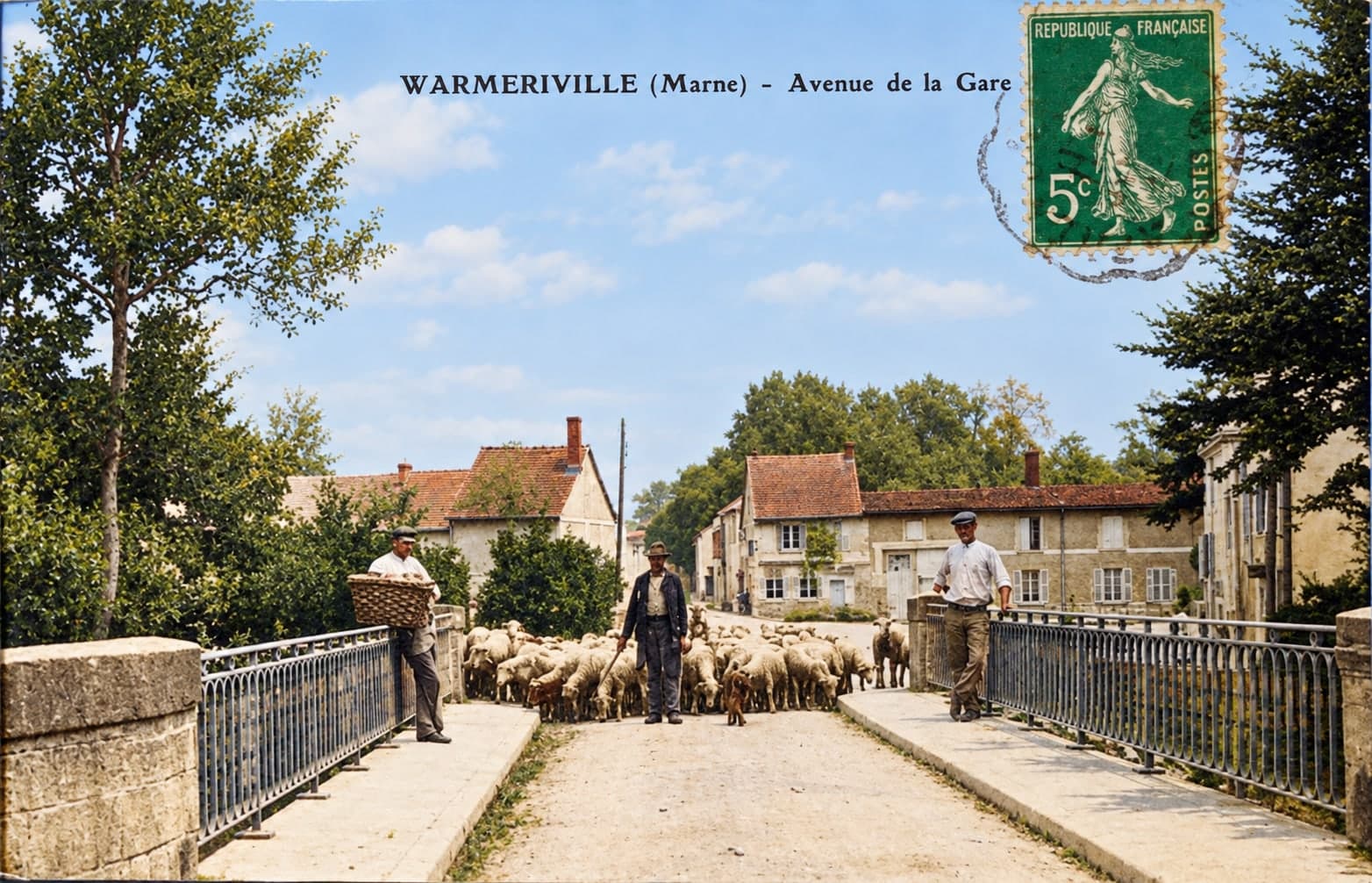
Warmeriville, avenue de la Gare: a flock of sheep on the Suippe bridge · early 20th century
Timeline 1810-2026
59 dates to follow a family, a mill and an idea, from the grandfather's first spinning machine to the Rimini exhibition. Filter by theme.
- 1810
Val-des-Bois
The Sainte-Cécile spinning mill
Jacques Harmel, Léon's grandfather, an Ardennes blacksmith who had become a yarn commission agent for the merchants of Reims, sets up a mechanical spinning mill at Sainte-Cécile (Belgian Luxembourg), equipped with Cockerill machines.
- 1824November
His life
His parents marry
At Rethel, Jacques-Joseph Harmel marries Alexandrine Tranchart, who comes from one of the town's leading families.
- 182917 February
His life
Léon is born
Pierre Louis Prosper Léon Harmel is born at La Neuville-lès-Wasigny, in the Ardennes, the fourth child in a family of eight. He is baptised on 8 March: his baptism record is held at the Archives départementales des Ardennes.
- 1833
Val-des-Bois
Harmel Frères
Jacques-Joseph Harmel goes into partnership with his brothers Hubert and Félix: the firm Harmel Frères is founded at Boulzicourt, in the Ardennes.
- 1840
Val-des-Bois
Val-des-Bois
Jacques-Joseph buys a wooded plot on the banks of the Suippe, away from the village of Warmeriville, near Reims. His wife names the place “Val-des-Bois”.
- 1841
Val-des-Bois
The mill starts up
The head office of Harmel Frères moves to Warmeriville and the wool spinning mill starts up. A first workers' housing estate is built.
- 1842
Val-des-Bois
Savings and interest-free loans
A savings fund paying 4% interest and an interest-free loan fund are set up for the workers.
- 18431843-1850
His life
The Senlis years
A pupil at the Collège Saint-Vincent in Senlis, Léon passes his baccalauréat in 1848 and considers the priesthood. He concludes that he is called “to the apostolate, but not to the priesthood”.
- 184621 January
Val-des-Bois
Mutual aid
Harmel Frères sets up a mutual aid society at the Val: it pays half wages in case of illness; the doctor and medicines are free.
- 18521 September
His life
Marriage to Jeanne-Gabrielle
At Rethel, Léon marries Jeanne-Gabrielle Harmel, the daughter of his uncle Hubert and of Laurence Tranchart, his mother's sister: they are first cousins twice over.
- 1854late 1854
Val-des-Bois
The son takes the helm
At 25, Léon takes over the actual running of the mill, while his exhausted father remains its legal head until 1884.
- 1855
Val-des-Bois
Houses with gardens
The communal housing block is pulled down and replaced by individual houses with gardens.
- 1860c. 1860
His life
The Franciscan Third Order
Léon joins the Third Order of St Francis (between 1860 and 1862, depending on the source): “the secret thread of his life”, as the Archbishop of Reims would later say.
- 185931 July
His life
Ernest healed at Liesse
Gravely ill, Ernest, Léon's favourite brother, is carried on a bed to the shrine of Notre-Dame de Liesse. He comes back healed; on 1 September, the family offers a silver heart as an ex-voto.
- 1861
Val-des-Bois
The schools of the Val
After the Brothers of the Christian Schools (1858), the Daughters of Charity arrive at the Val. Schools for boys and for girls open their doors.
- 186428 July
His life
The will of the first Good Father
At Val-des-Bois, Jacques-Joseph Harmel writes his last recommendations to his children: “Love our dear workers; they were my children; you will take up my fatherhood.” The will is printed after his death, in 1884.
- 187016 October
His life
Widowed
His wife, Jeanne-Gabrielle, dies at 37. Léon is left alone with eight children, the eldest aged sixteen; he never remarries.
- 1873
Church & society
With de Mun and La Tour du Pin
Léon meets Albert de Mun and René de La Tour du Pin and commits himself to the Catholic Workers' Circles (Œuvre des cercles catholiques d'ouvriers).
- 187413 September
Val-des-Bois
The fire
Fire destroys the mill and its four storeys. While work is at a standstill, wages continue to be paid.
- 1875
Val-des-Bois
Rebuilding and the Christian Corporation
The mill rises again on a single level, covering 24,150 m². “Our ruins have been rising slowly,” Léon writes to a friend in April. The associations of the Val are federated into a “Christian Corporation”. On 24 August, Archbishop Langénieux blesses Our Lady of the Factory (Notre-Dame de l'Usine).
- 1877
Church & society
Manuel d'une corporation chrétienne
Harmel publishes, with Mame in Tours, a reasoned account of his experience. The second edition (1879) will make the Val known throughout Catholic Europe.
- 18796 October
Val-des-Bois
The cooperative
A consumer cooperative, managed by a majority of workers, opens at the Val. That same year, a brief from Leo XIII praises the work.
- 1883
Val-des-Bois
The Professional Council
Workers meet with the management to deal with production, wages, apprenticeship and hygiene: the forerunner of the Factory Council.
- 18843 March
His life
Death of his father
Jacques-Joseph Harmel, founder of the Val and the first “Good Father”, dies at Val-des-Bois, surrounded by his children, grandchildren and great-grandchildren. His family and the workers then give Léon the name of “Good Father”.
- 1885
Church & society
First pilgrimage to Rome
In February, about a hundred Christian employers travel to Rome with Archbishop Langénieux. This is the beginning of “La France du Travail à Rome” (Labour France in Rome).
- 18868 December
Val-des-Bois
Our Lady of the Factory, a partner
On the initiative of Ernest Harmel, who had died the year before, the partnership deed of Harmel Frères lists Our Lady of the Factory (Notre-Dame de l'Usine) among the partners: she receives a share of the profits, at first equal to that of each managing partner, then set at 11% in 1905.
- 1887October
Church & society
1,800 pilgrims
A hundred employers, 1,400 workers and 300 priests are received by Leo XIII. On the way there, Don Bosco blesses the pilgrims in Turin.
- 1889
Church & society
The Catéchisme du patron and 10,000 pilgrims
In January, the Catéchisme du patron (Employer's Catechism) appears, “drawn up with the help of a great many theologians”. In October, some 10,000 workers and employers make their way to Rome.
- 189115 May
Church & society
Rerum Novarum
Leo XIII publishes the encyclical on the condition of the workers. Cardinal Langénieux is authorised to present it as “the reward of the workers' pilgrimages”.
- 1891September
Church & society
The 1891 pilgrimage
Some 20,000 pilgrims are expected. On 3 October, the front page of Le Monde illustré shows Leo XIII saying Mass before the French workers.
- 1891
Val-des-Bois
The family fund
A “family wage supplement”, financed by the company and managed by a workers' committee, tops up wages according to family responsibilities: a forerunner of family allowances.
- 1892
Val-des-Bois
Sabadell
Harmel Frères opens a subsidiary in Sabadell, in Catalonia. That same year, Harmel distances himself from Albert de Mun.
- 1893
Val-des-Bois
The Factory Council
The Professional Council takes the name of Factory Council. In May, Harmel convenes a Christian workers' congress in Reims.
- 18941894-1895
Val-des-Bois
A time of questioning
Tensions at the Val and a debate with the Catholic employers of the Nord over the place of workers' trade unions: Harmel draws the lessons and adapts his model.
- 1896
Church & society
Congresses in Reims and Lyon
An ecclesiastical congress is held in Reims at the initiative of Abbé Lemire; in November, Harmel speaks at the national congress of Christian democracy in Lyon.
- 1897
Church & society
The Val, a training school
The pilgrimages resume. Seminarians and young priests come to the Val to learn about the social question; Marc Sangnier also spends time there.
- 1900
Val-des-Bois
The Val in photographs
An album of 116 photographs records the mill, its workshops, its institutions and its people. It is now held at the Archives de la Marne, in the Harmel company collection (fonds de la société Harmel).
- 1903
Val-des-Bois
“La démocratie dans l'usine”
In Rome, Harmel explains how the Factory Council works. On 24 December, the union of the Val becomes a purely workers' union.
- 1904
Church & society
The Semaines sociales
The first Semaine sociale de France (Social Week) is held in Lyon, following on from the study sessions organised at Val-des-Bois.
- 1905Christmas
His life
“A Republican by conviction”
In the Échos du Val des Bois, the mill's new bulletin, Harmel writes: “Yes, I am a Republican, not one who has merely rallied, but a Republican by conviction and by principle.”
- 190622 April
His life
Wishes to his grandchildren
Now in his 78th year, the Good Father sends his grandchildren printed wishes: “As long as you remain in business, you must work like poor people.”
- 1908
His life
The Good Father in his 80th year
Official portrait of “le bon père Léon Harmel” (the Good Father Léon Harmel), in his eightieth year.
- 1914
His life
The war
In Rome, Harmel defends the Christian trade unions. On 23 August, he records his last recommendations on a Pathé disc. On 4 September, the Germans move into the Val.
- 191525 November
His life
Death in Nice
Taken ill with fever on returning from a retreat of the Franciscan tertiaries, Léon Harmel dies in Nice, aged 86, far from his occupied mill, after blessing his family: “Union, the work of life; division, the work of death. All through the Sacred Heart.” The funeral is held on 27 November at Sainte-Hélène; he now rests at Warmeriville.
- 1918October
Val-des-Bois
The mill blown up
As early as July, the German army had blown up a tall chimney; as it withdraws, it dynamites the mill and the chapel. Warmeriville is liberated on 11 October.
- 1922
Val-des-Bois
Rebirth
Rebuilt by its workers, the mill reopens, together with its schools. It will grant paid holidays ten years before the law required it.
- 1927
Legacy
First major biography
Father Georges Guitton, a Jesuit, publishes Léon Harmel in two volumes.
- 1929
Legacy
The centenary
A centenary committee celebrates the birth of the Good Father. In Paris, in the Basilica of Montmartre, Bishop Tissier of Châlons delivers his eulogy, “Les trois grands amours d'une grande vie sociale : l'ouvrier, le pape, le Christ” (The three great loves of a great social life: the worker, the Pope, Christ), in the presence of the apostolic nuncio.
- 1931
Legacy
Quadragesimo anno
Pius XI praises the family wage, defines subsidiarity and hopes to temper the wage contract with elements of the partnership contract: three insights from the Val, though Harmel is not named.
- 193211 March
Legacy
Family allowances for all
After Émile Romanet in Grenoble (1916) and the equalisation funds, the law extends family allowances to all.
- 1938
Legacy
A cause for beatification
Cardinal Suhard, Archbishop of Reims, opens a first cause for beatification.
- 1945
Legacy
From Factory Council to works council
The ordinance of 22 February creates works councils (comités d'entreprise); at the Val, the Factory Council becomes a works council.
- 1977
Legacy
The end of the family firm
After more than a century of activity, the family firm closes; a workers' cooperative carries on the business for a few years.
- 2003
Legacy
An American biography
The historian Joan L. Coffey publishes Léon Harmel: Entrepreneur as Catholic Social Reformer with the University of Notre Dame Press (United States).
- 2009
Legacy
Demolition
The last large building of the Val, which housed Léon Harmel's office, makes way for housing and a school.
- 201514 November
Legacy
The centenary of his death
More than 850 people gather in Reims and Warmeriville: lectures at the Maison Saint-Sixte, Mass in the Basilica of Saint-Remi with the Archbishop of Reims, a message from Pope Francis, an exhibition in Warmeriville.
- 2017October
Legacy
The Parc Harmel
Warmeriville opens a public park and a Cercle hall on the site of the former mill.
- 2025
Legacy
Fresh momentum
Émeric Saucourt-Harmel publishes a biography with Salvator. On 25 November, in Reims Cathedral, the diocese announces a step towards beatification.
- 202622 August
Legacy
Leo XIV at the Rimini exhibition
Pope Leo XIV visits the exhibition “Léon Harmel. La profezia di un'impresa” (The Prophecy of an Enterprise) at the Rimini Meeting.
Some dates vary from one source to another (marriage, Third Order, pilgrimages, closure of the mill): see the note on method on the Sources page.