Skip to content
LHLéon Harmel, back to the home page
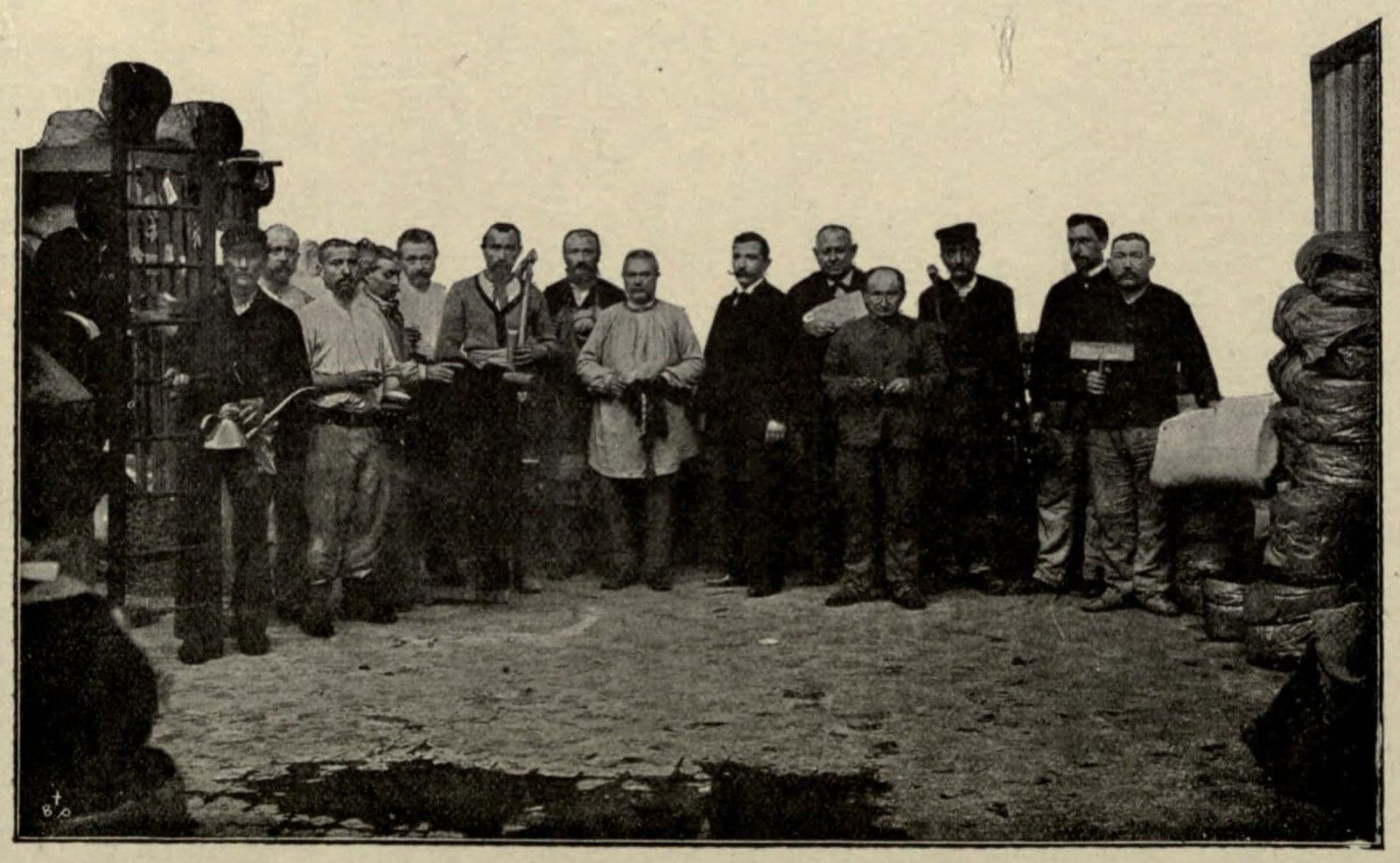
Group photograph: some fifteen workers of the Factory Council, standing in a courtyard of the mill, each holding a tool or a product of their trade.

Members of the Factory Council of the Harmel works · published 1905

Room IV · Modernity

An employer ahead of his time

Works councils, family allowances, participation, training: more than half a century before the law, Val-des-Bois was already putting them into practice, in its own way.

Legacy

A legacy alive and well

Léon Harmel did not wait for the law to act. At Val-des-Bois, long before social security and works councils, he devised, one institution after another, a way of working together founded on trust and responsibility. These were not yet rights guaranteed by the State, but the choices of an employer convinced that the mill must serve people and families.

Many of these insights can be found today, transformed, in French social law. The cards below set what existed at Val-des-Bois alongside what exists in France today.

The good of the worker through the worker and with him, as far as possible; never without him and, all the more so, never in spite of him.
Léon Harmel · 1903
Lineage

Then at the Val, in France today

Social dialogue

At Val-des-Bois · 1883-1893

The Factory Council

Elected workers met the management every fortnight to discuss production, working hours, bonuses, apprenticeship, hygiene and safety. The Maitron sees it as a “prefiguration of works councils”; for the historian Pierre Trimouille, it “in reality played a more important role than most” of them.

Today · 1945 → 2017

Works council, then CSE

The ordinance of 22 February 1945 created works councils (comités d'entreprise), replaced from 2017 by the social and economic committee (CSE). At the Val, the Factory Council quite naturally became a works council as early as 1945.

Family allowances

At Val-des-Bois · 1891

The family fund

A wage supplement, financed by the company and managed by a workers' committee, helped each household according to the number of dependants, a quarter of a century before the first allowances. The historian Pierre Trimouille sees Harmel as “the principal initiator of family allowances”.

Today · 1916 → 1932

From Romanet to the allowance funds

Émile Romanet took up the idea in Grenoble (1916), then equalisation funds shared it among companies; the law of 11 March 1932 extended family allowances to the whole of France.

Participation

At Val-des-Bois · 1882

“Participation in our authority”

In a letter to L'Univers, Harmel was already speaking of “participation”: “for the first time, no doubt, an employer speaks of ‘participation’”, notes the historian Pierre Trimouille. He involved the workers in running the mill and rewarded their inventions.

Today · 1959 · 1967

Incentive schemes and profit-sharing

The ordinances of 1959 and 1967 gave employees a share in company results. For the researcher Pierre-Yves Gomez, Harmel already saw participation as “a question of justice, but also of economic efficiency”.

Social protection

At Val-des-Bois · 1842-1896

Funds, mutual aid, wages maintained

Savings, interest-free loans, half wages in case of illness, free medical care. And when the mill stopped, in 1848, in 1870 or after the fire of 1874, wages continued to be paid.

Today · 1945

Social security and mutual insurance

What the Val organised on the scale of a single mill is now the business of social security, mutual insurers and unemployment insurance.

Subsidiarity

At Val-des-Bois · 1884-1903

“Through the worker and with him”

Whatever the workers could run themselves (the theatre, the cooperative, the associations), Harmel entrusted to them. He spoke of “responsibility”: everyone must have their share.

Today · 1931 → today

Subsidiarity and participatory management

Pius XI gave this idea the name of subsidiarity in 1931; today companies speak of team autonomy and of decisions taken as close as possible to where the work is done.

The purpose of a company

Our reading

At Val-des-Bois · 1877-1903

The company as a community

For Harmel, the mill had duties towards people and families, not only towards its shareholders.

Today · 2019

CSR, the PACTE law, mission-driven companies

The PACTE law allows companies to write a “raison d'être” (purpose) into their articles of association. Researchers see Harmel as a forerunner of corporate social responsibility; the comparison with the PACTE law is our own.

Christian employers

At Val-des-Bois · 1891

The Union fraternelle

Harmel founded an association of Christian employers, the Union fraternelle du commerce et de l'industrie (Fraternal Union of Commerce and Industry).

Today · 1926 → 2026

Christian Entrepreneurs and Executives

It was one of the components of the Confédération française des professions (1926), forerunner of the EDC, which celebrated its centenary in 2026 by putting him in the spotlight.

1879-2026

From Leo XIII to Leo XIV

  1. 1879-1891Leo XIIIPraised the work of the Val (brief of 1879), received the workers' pilgrimages, published Rerum Novarum. “The Harmels must multiply,” he is said to have remarked.
  2. 1914Pius XHarmel, at eighty-five, came to Rome once more to defend the Christian trade unions.
  3. 1931Pius XIQuadragesimo anno enshrined the family wage and subsidiarity, two ideas dear to Val-des-Bois.
  4. 1981John Paul IILaborem exercens (§ 14) argued for workers' participation in the management and profits of companies.
  5. 2026Leo XIVOn 22 August, the pope visited the exhibition devoted to Harmel at the Rimini Meeting.

Luigi Giussani, founder of Communion and Liberation, saw him as the only entrepreneur to have truly put Catholic social teaching into practice.

Perspective

A man of his time

Léon Harmel was a man of the 19th century, and he built his work with the ideas of his time. He saw the mill as a great Christian family, of which he wished to be the father: his workers indeed called him “the Good Father”. Life at the Val was shaped by faith and by rules that would seem very strict today, and the final decision rested with the employer.

What stands out is his capacity to evolve. Starting from the corporative model, he made ever more room for the workers: he had the Factory Council elected by all the workers of each workroom, supported independent workers' unions, and called himself a “republican by conviction”. He summed it up himself: “I was a democrat by instinct. I became one by reason, for Christ and for the people.”

Léon Harmel is a leading figure, whose immense modesty has prevented history from paying him the tribute he deserves.
Pierre Pierrard, historian · 1988

Historians pay tribute to this commitment. Georges Hoog called him “familialist” rather than paternalist, Annie Kriegel saw him as a “Catholic Quaker”, and Pierre Trimouille, who studied the mill's archives, considers that he helped “to prevent a total divorce between the working class and the Church”. Leo XIII himself is said to have wished to see “the Harmels multiply”.

Today

Memory and the present

In Warmeriville

The mill closed its doors at the end of the 1970s, and most of its buildings have since disappeared. But Val-des-Bois has not forgotten: since October 2017, the Parc Harmel and a hall of the Cercle have welcomed local residents on the site of the former mill, near the avenue du Val-des-Bois, and the Val-des-Bois private school carries on the educational work that the Harmel family wished for. Léon Harmel is buried in Warmeriville.

Towards beatification

A first cause for beatification was opened in 1938 by Cardinal Suhard, Archbishop of Reims. On 25 November 2025, at the Mass celebrated in Reims Cathedral for the 110th anniversary of his death, the diocese announced that it was undertaking a new process towards his beatification. The journey is only just beginning.

Renewed interest

  • 2025: biography by Émeric Saucourt-Harmel, published by Salvator with a preface by Archbishop Éric de Moulins-Beaufort, awarded the Prix Humanisme chrétien in 2026.
  • March 2026: at the centenary of the Christian Entrepreneurs and Executives (EDC), in Lyon, Harmel takes centre stage.
  • 21-26 August 2026: exhibition “Léon Harmel. La profezia di un'impresa” (The Prophecy of an Enterprise) at the Rimini Meeting, visited by Pope Leo XIV on 22 August (watch the visit on video).
  • Streets bear his name in Antony and Brest; since 2004, the Institut politique Léon-Harmel in Paris has offered training in social ethics.

Keeping his memory alive

This site is part of that movement: gathering archives, images and texts so that the work of the “Good Father” is not forgotten and continues to inspire all those who want to make a business a community of people.

“École de garçons” (Boys' school, postcard B.5)·c. 1905-1914Old postcard, Harmel Frères · G. Garitan collection, via Wikimedia Commons · CC BY-SA 4.0 (declared licence)
The church of Saint-Martin in Warmeriville·c. 1900Old postcard · G. Garitan collection, via Wikimedia Commons · CC BY-SA 4.0 (declared licence)
In Antony, in the Hauts-de-Seine, an avenue bears his name.·2023Photo by Chabe01 · Wikimedia Commons · CC BY-SA 4.0
Born at Val-des-Bois, the devotion to Our Lady of the Factory (Notre-Dame de l'Usine) travelled far: this statue, with a cogwheel at her feet, keeps watch in the church of Saint-Joseph in Roubaix.·late 19th century (photographed in 2021)Photo by Etienne5962 · Wikimedia Commons · CC BY-SA 4.0
Continue the tourTimelineEvery date, from the grandfather's spinning mill in 1810 to the Rimini exhibition in 2026.