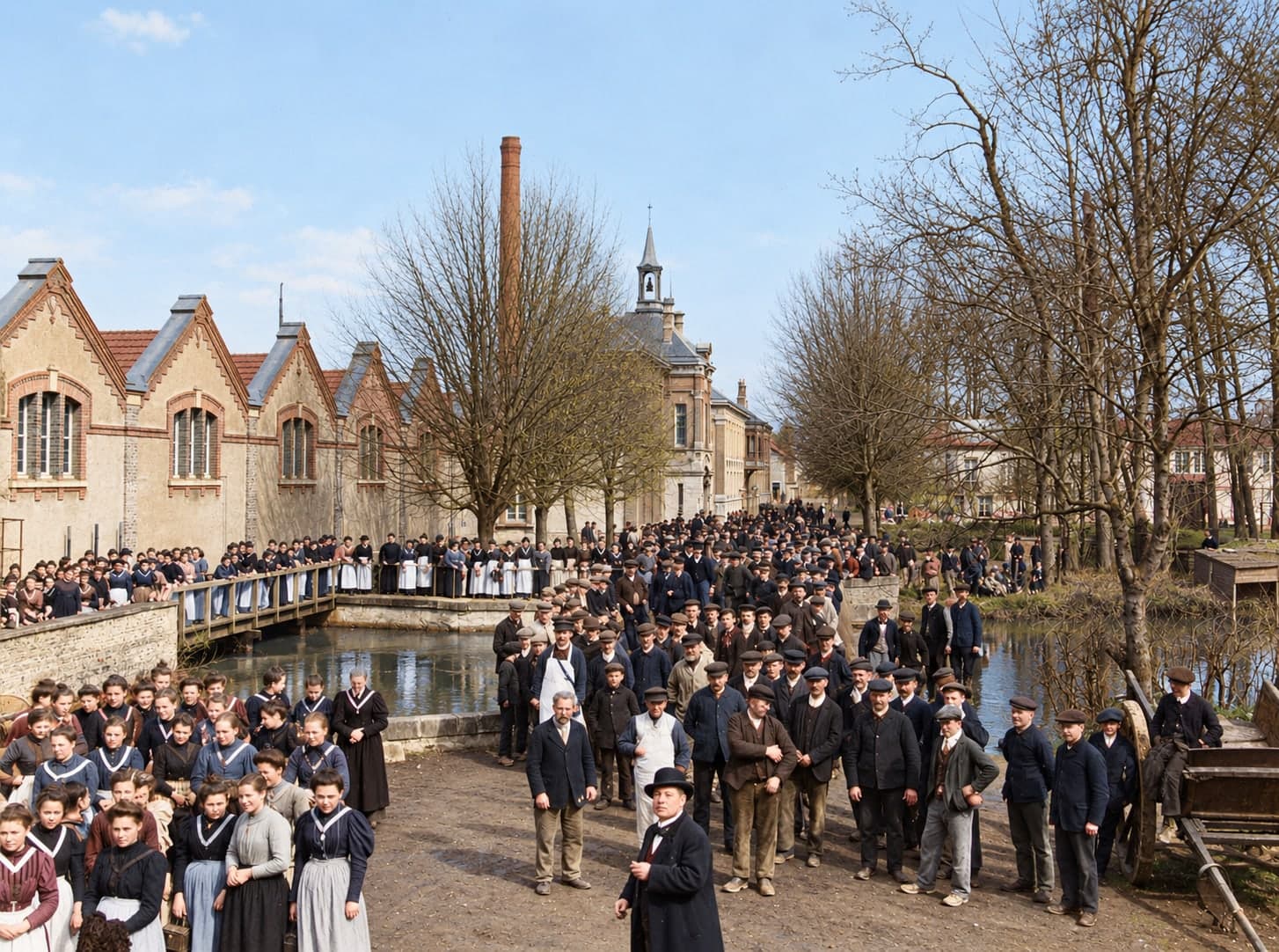
The workforce leaving the mill, beside the Suippe · 1900
Val-des-Bois, the Christian factory
A combed-wool spinning mill on the banks of the Suippe, at Warmeriville. For sixty years, Léon Harmel tested there, one institution after another, what a business run “with” the workers could be.
- The spinning mill starts up at Val-des-Bois
- 1841The spinning mill starts up at Val-des-Bois
- of single-level workshops, rebuilt in 1875
- 24,150 m²of single-level workshops, rebuilt in 1875
- men and women workers around 1900
- ≈ 700men and women workers around 1900
- Interval between Factory Council meetings with the management
- 2 weeksInterval between Factory Council meetings with the management
A mill in a valley
Val-des-Bois was not an industrial suburb but a wooded valley set apart from the village, at the heart of the Reims wool district. Combed wool was spun there. In 1849, a steam engine was installed; the mill then had 145 workers. There were around 550 in 1867, and nearly 700 around 1900.
Around the workshops a small world gradually took shape: workers' houses, schools, a chapel, a club, a cooperative, a wash house, a family home for young women. The experiment attracted visitors from all over Europe, and in 1905 an English book on “model factories” still gave it a place.
Take a walk through the Val of 1900: on the view drawn by Abbé Chevallier, or on the general plan held at the Archives de la Marne, each number opens an information card and a period photograph.
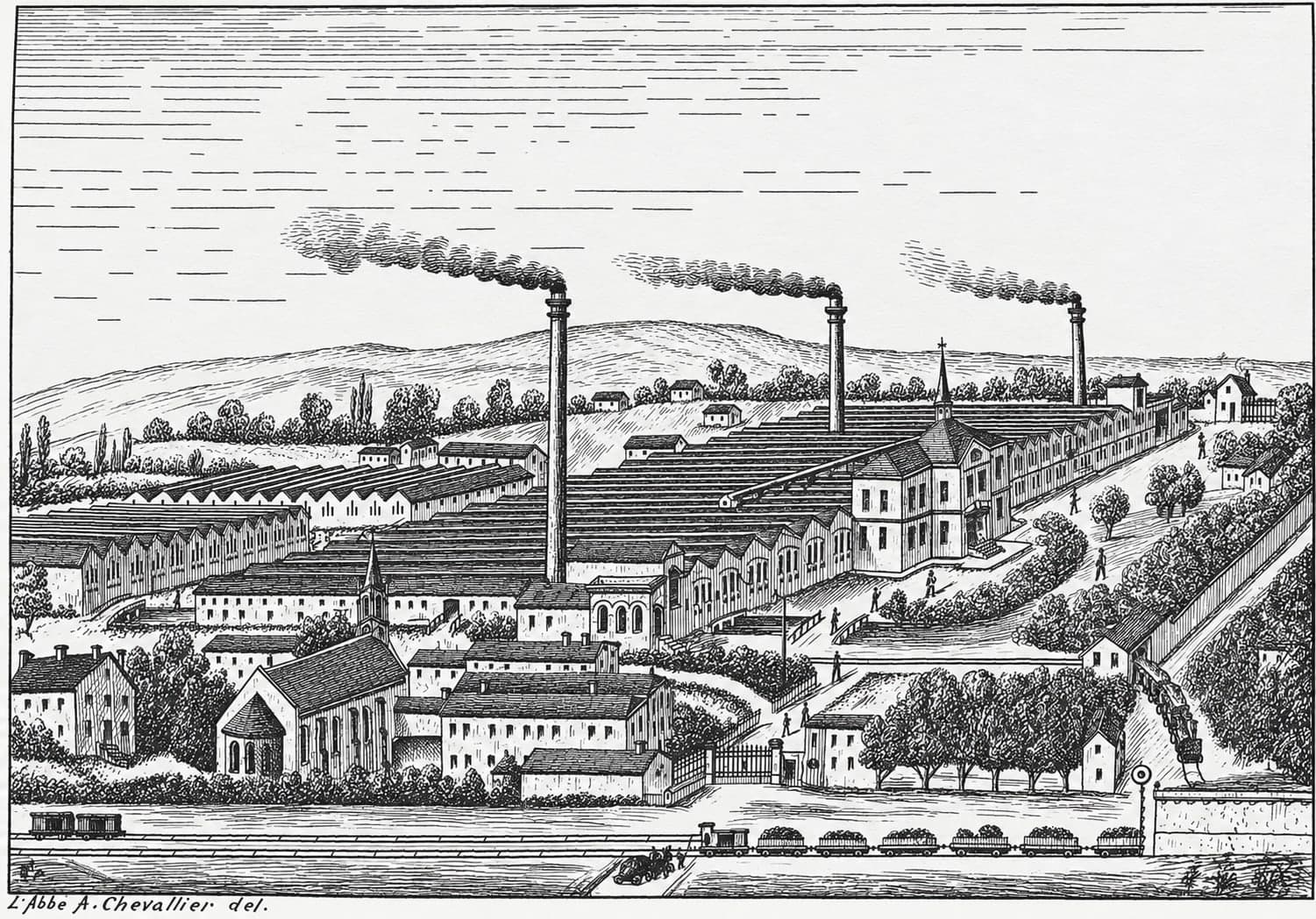
Point 1 of 6 · 1840
The Suippe valley
In 1840, Jacques-Joseph Harmel bought a plot of woodland on the banks of the Suippe, away from the village of Warmeriville. It was his wife who named the place “Val-des-Bois”. The spinning mill started up there the following year.
“Val-des-Bois”, bird's-eye view of the mill · Drawing by Abbé A. Chevallier · Cousin-Henrat, Étude historique sur Warmeriville, Reims, 1900 · Source gallica.bnf.fr / BnF
Two photographers, in the same spot, a few years apart: drag the slider to move from one period to the other.
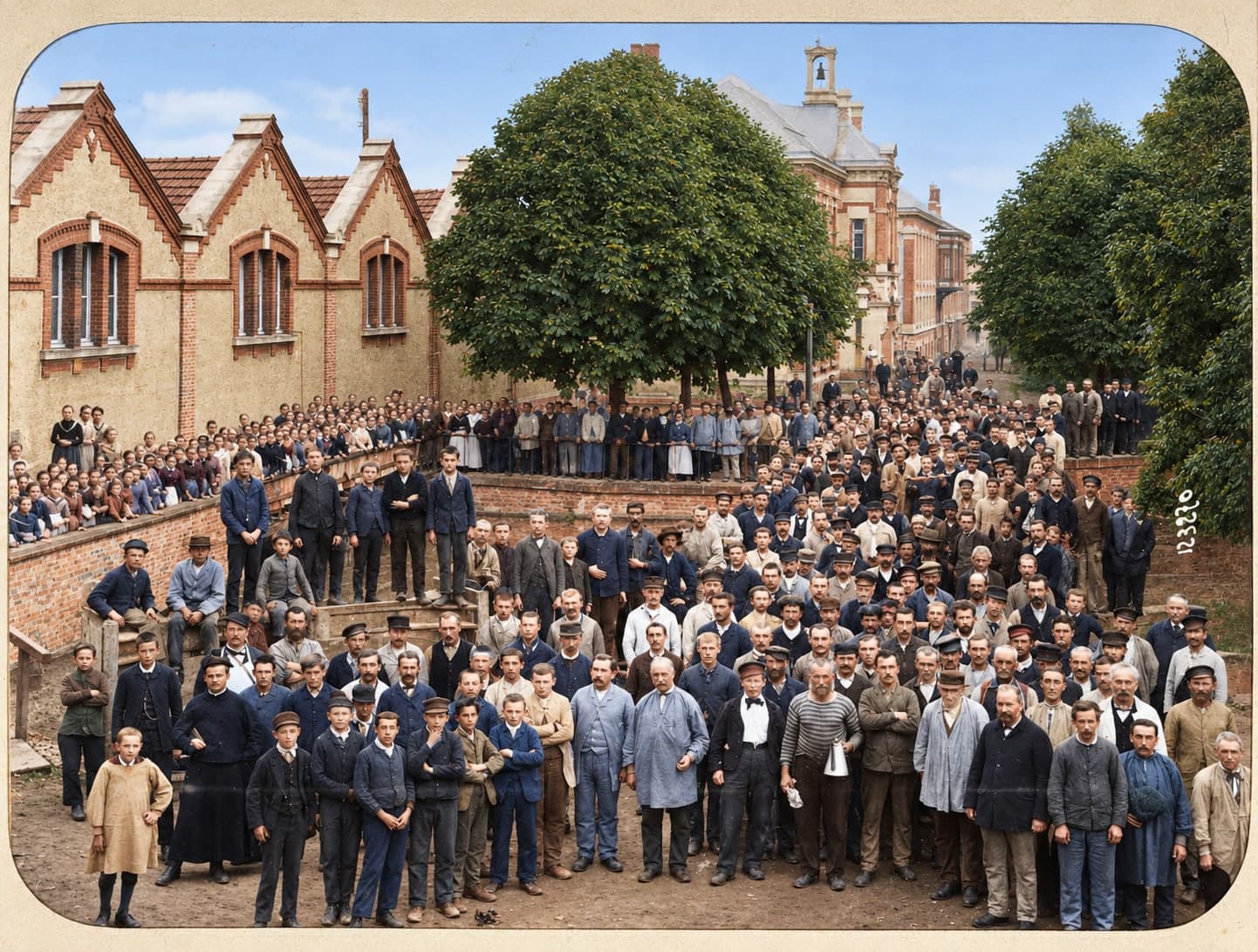
The same gabled workshops, the same small bell tower: the staff photographed for the 1891 album, then for the 1900 album, in the same spot.
Saving, health care, housing
Long before any social legislation, the Val provided itself with collective protection. From 1842, a savings fund paid 4% interest on workers' savings, and an interest-free loan fund spared them from turning to moneylenders. On 21 January 1846, Harmel Frères set up a mutual aid society: it paid half wages in case of illness; doctor and medicines were free. Then came accident insurance, a mutual pharmacy, a pension fund and a retirement home.
More remarkable still: the continuity of wages. When the mill stopped (the revolution of 1848, the war of 1870, the fire of 1874, the crisis of 1896), the workers went on being paid. The historian Pierre Trimouille hails this as “a kind of right to work”, well ahead of its time.
Housing followed. From 1855, the communal housing of 1841 was replaced by individual houses with gardens, later managed by a property company.
Schooling the Val's children
The Brothers of the Christian Schools arrived at the Val in 1858, the Daughters of Charity in 1861: boys' and girls' schools opened their doors. Léon Harmel himself took charge of the boys' school in 1875.
From 1864 to 1958, the Maison Sainte-Marie, known as the “Maison de famille” (family home), took in young women workers and orphan girls as boarders. Apprenticeship was the subject of competitions and then, in 1910, of an apprenticeship council.
Of all these institutions, only one survives today: the Val-des-Bois private school, which the Archbishop of Reims calls “the only living remnant of the Mill”.
The Christian Corporation
In 1875, in the aftermath of the fire, Harmel federated the Val's associations into a Christian Corporation, a word dear to his friend René de La Tour du Pin, who wanted to revive the spirit of the old trade guilds. It was governed by an employers' committee, an internal council and a mixed corporate council: in 1890, the latter brought together seven employers or clerks and eight workers.
Religious life was at its heart. The statue of Our Lady of the Factory (Notre-Dame de l'Usine), blessed on 24 August 1875, became the focus of a confraternity raised to an archconfraternity in 1879; daily Mass, associations for men, young men and young women, and a resident chaplain set the rhythm of life at the Val. On the initiative of Ernest Harmel, the Virgin even became a partner in the firm: the partnership deed of 8 December 1886 listed Our Lady of the Factory among the partners of Harmel Frères, with a share of the profits set at 11% in 1905.
On 6 October 1879 a consumer cooperative society was born. It was run by a majority of workers: twelve of the fourteen directors in 1890.
The Factory Council
This is the innovation people still talk about. In 1883, Harmel brought workers together in a Professional Council, an advisory body, which in 1893 took the name of Factory Council. Its members met every fortnight with one of the employers. They dealt with production, working hours, rates and bonuses, apprenticeship, hygiene and accident prevention.
From 1903, each councillor was elected by all the workers in his workroom. Ideas also came from below: around 1905, a worker's invention was rewarded with 5,000 francs; in 1909, technical improvements were tried out under the Council's supervision. In 1945, it would quite naturally become the Val's works council.
The more participation in our authority we have given the workers, the more trust and devotion they have returned to us.
The family fund
The same wage does not support a single man and a father of six in the same way. Starting from this observation, Harmel created in 1891, the year of Rerum Novarum, a family fund: financed by the company and managed by a workers' committee, it paid a “family wage supplement” that guaranteed each household a minimum according to the number of dependants.
The history of family allowances remembers him as a pioneer: the Comité d'histoire de la Sécurité sociale notes that he set up “a Family Fund as early as 1891”, and the historian Pierre Trimouille sees him as “the principal initiator of family allowances”. Émile Romanet took up the idea in Grenoble in 1916, before the law of 11 March 1932 extended family allowances to the whole of France.
Life at the Val
The Cercle (club) was the heart of social life: a theatre hall sixteen metres by sixteen, a union hall with six billiard tables, a refreshment bar and a library. The Harmonie band had been playing since 1847. At the heated wash house, the women did their laundry under cover. Harmel urged the workers to run these activities themselves: if the theatre could be managed without the employer, the employer had no business meddling in it. Shaped by faith, life at the Val followed a demanding rule, like the Christian communities of the time.
Towards a workers' union
In 1885, Harmel founded a mixed union at the Val, bringing together employers and workers on the corporative model. But experience changed his thinking. In 1893-1894, he held congresses of workers alone in Reims, even at the cost of clashing with the Catholic employers of the Nord, who were attached to mixed unions. At the Val itself, the tensions of 1894-1895 led him to acknowledge that he had sometimes governed too much on his own, and to learn from it.
On 24 December 1903, the Val's union became a purely workers' union. It was the end of the Christian Corporation, and above all a sign that Harmel knew how to make his own model evolve so as to leave ever more room for the workers.
Where there is no association for good, the workers find themselves handed over, defenceless, to association for evil, which is always tyrannical.
The institutions of the Val
- 1842Savings fund (4%) and interest-free loans
- 1846Mutual aid society
- 1847Harmonie (wind band)
- 1855Individual houses with gardens
- 1858-61Boys' and girls' schools
- 1864Family home for young women workers
- 1875Christian Corporation
- 1879Consumer cooperative
- 1883Professional Council, later the Factory Council
- 1885Mixed union
- 1891Family fund
- 1910Apprenticeship council
In 1890, the Catholic Workers' Circles (Œuvre des cercles) devoted an entire brochure to these institutions: Le Val-des-Bois et ses institutions ouvrières (Val-des-Bois and Its Workers' Institutions), written for the visit of Bishop Doutreloux of Liège on the feast of Our Lady of the Factory. The Val had become a model that people came to see.