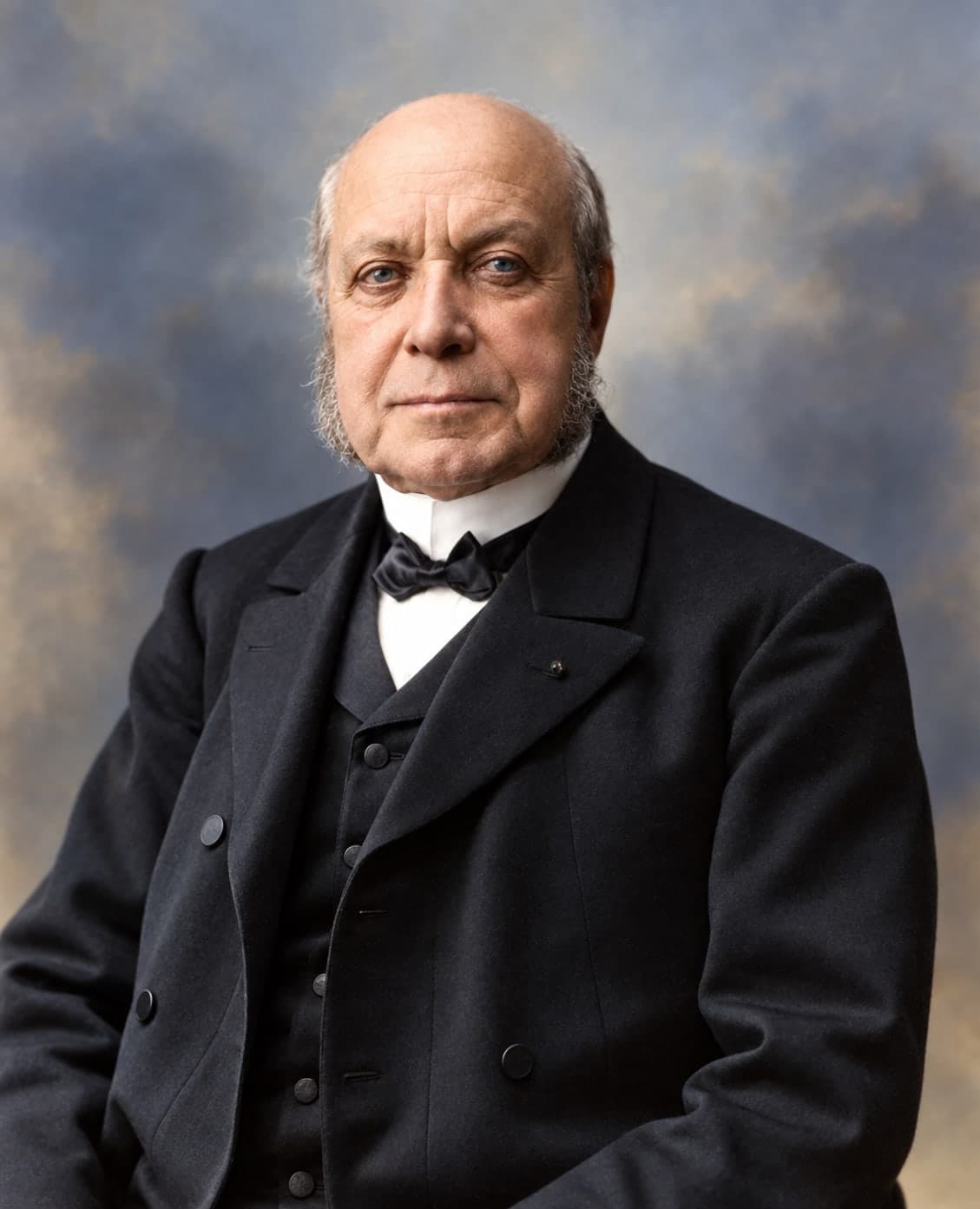
Léon Harmel · c. 1905
His life 1829-1915
Eighty-six years of a life bound up entirely with a mill in the Suippe valley, and with one conviction: a business can be a community of people.
A family of Ardennes spinners
The story begins with a blacksmith. Jacques Harmel, the grandfather, born in 1763 at Pouru-aux-Bois in the Ardennes, settled at Sainte-Cécile, in Belgian Luxembourg. He became a yarn commission agent for the merchants of Reims, set up a workshop around 1800 and then, in 1810, a true mechanised spinning mill equipped with machines from Cockerill, the great engineering firm of Liège.
When Sainte-Cécile ceased to be French, in 1815, the family, wishing to remain French, settled in the Ardennes: first at Angecourt, then at La Neuville-lès-Wasigny, where the son, Jacques-Joseph (1795-1884), took over the spinning mill around 1820 and made the family business truly flourish. In November 1824, at Rethel, he married Alexandrine Tranchart, from one of the town's leading families. In 1833, he went into partnership with his brothers Hubert and Félix: the firm Harmel Frères was founded at Boulzicourt, in the Ardennes.
It was into this world of small textile manufacturers that Pierre Louis Prosper Léon Harmel was born, on 17 February 1829 at La Neuville-lès-Wasigny: he would be known by his fourth given name, Léon. He was the fourth of eight children, five of whom survived. He was baptised on the following 8 March by Abbé Remi Joseph Culot, parish priest of Wasigny; his godfather, Pierre Tranchart, a manufacturer at Rethel, bore his mother's surname.
In 1840, Jacques-Joseph bought a plot of woodland on the banks of the Suippe, away from the village of Warmeriville, less than twenty kilometres from Reims, a major wool centre. His wife gave the place its name: it would be the Val-des-Bois. The mill started up in 1841.
“In the year of grace one thousand eight hundred and twenty-nine, on the eighth day of the month of March, I, Remi Joseph Culot, priest, parish priest serving the parish of Saint-Remi of Wasigny, baptised a child of the male sex born on the seventeenth day of the month of February last, of the lawful and Catholic marriage of Jacques Joseph Harmel, spinner, and of Anne Alexandrine Tranchart, his father and mother, residing at La Neuville-lès-Wasigny, to whom were given the names Pierre Louis Prosper Léon.”
Opening of the record, transcribed with modernised spelling and translated from the French. View the register at the Archives départementales des Ardennes.
Senlis, or an apostle's calling
From 1843 to 1850, Léon was a boarder at the Collège Saint-Vincent in Senlis. He passed his baccalauréat in 1848, the year barricades went up across Paris during the June Days, and joined the Society of Saint Vincent de Paul, founded in 1833 around Frédéric Ozanam to visit the poor.
For two years, the young man wondered whether he should become a priest. He concluded that he was called “to the apostolate, but not to the priesthood”. His whole life is summed up in that phrase: it was as a layman, as the head of a business, that he meant to serve.
Employer at twenty-five
On 1 September 1852, at Rethel, Léon married Jeanne-Gabrielle Harmel, the daughter of his uncle Hubert and of Laurence Tranchart, his mother's sister: they were first cousins twice over. At the end of 1854, his exhausted father handed him the actual running of the mill. He was twenty-five. Jacques-Joseph, already nicknamed “the Good Father” by the workers, remained the legal head of the firm until his death in 1884; the nickname would pass to the son.
The young employer inherited institutions that were already remarkable: a savings bank and an interest-free loan fund (1842), a mutual aid society (1846), a wind band. He developed them methodically. As early as 1855, he had the communal workers' housing built in 1841 pulled down and replaced it with individual houses with gardens. The Brothers of the Christian Schools (1858) and the Daughters of Charity (1861) opened schools; weekly and then daily Mass, and associations for young women (1863) and for men (1867), gave shape to life at the Val.
Around 1860, Léon joined the Franciscan Third Order, the branch of the order of Saint Francis open to married lay people. In 2025, the Archbishop of Reims would describe it as “the secret thread of his life”. His younger brother Ernest, his lifelong confidant, was then gravely ill: on 31 July 1859, he was carried on a bed to the Marian shrine of Liesse, and came back healed; the family offered a silver heart as an ex-voto.
The loss of 1870
On 16 October 1870, as France was collapsing before Prussia, his wife, Jeanne-Gabrielle, died at the age of thirty-seven. Léon was left alone with eight children, the eldest of them sixteen. He never remarried.
This ordeal coincided with a turning point. In the aftermath of the Commune, a handful of Catholics, among them the army officer Albert de Mun and the Marquis René de La Tour du Pin, set out to reconcile the Church and the working class by founding “Catholic Workers' Circles”. Léon Harmel joined them as early as 1873. He brought them what they lacked: a mill where ideas were put to the test of reality.
The fire of 1874
On 13 September 1874, fire ravaged the Val-des-Bois mill and its four storeys. Le Figaro reported that “250 workers and their families find themselves without means of support”. At the Val, however, wages were maintained while work was at a standstill: Harmel had already done so in 1848 and in 1870, and would do so again in 1896.
Rebuilding was swift: by 1875, a new mill of 24,150 m², all on a single level, was rising from the ground. That was also the year when the Val's associations were federated into a “Christian Corporation”, and when the devotion born of the disaster took shape: on 24 August 1875, Archbishop Langénieux of Reims blessed the statue and the chapel of Our Lady of the Factory (Notre-Dame de l'Usine).
In the spring of 1875, Léon sent news to his friend Théodore Hersart de La Villemarqué, the Breton scholar who wrote the Barzaz Breiz. His letter, held at the Archives du Finistère, describes the rebuilding from the inside.
“Our ruins have been rising slowly so far. An exceptionally harsh winter prevented us from resuming our work as quickly as we would have wished. We still have part of our staff at La Neuville lez Wasigny (Ardennes); a large part stayed or has come back and is working to rebuild the mill. This terrible catastrophe has singularly increased the duties of our state in life.”
Léon Harmel, letter of 9 April 1875 to Théodore Hersart de La Villemarqué (extract). Archives départementales du Finistère, 263 J 2 1524.
The call of Rome
The Manuel d'une corporation chrétienne (Handbook of a Christian Corporation, 1877) made the Val known throughout Catholic Europe. Leo XIII, elected pope in 1878, praised its work as early as 1879. Harmel, who had a gift for bringing people together, then conceived a bold idea: to take to Rome not a few notables, but workers.
After a first journey by employers in 1885, the pilgrimage of October 1887 brought together some 1,800 people: a hundred employers, 1,400 workers, 300 priests. In October 1889, there were nearly 10,000 of them. That same year, in a private audience, Leo XIII confided to Harmel: “Today it is the workers who are the greatest number, who have the power of the vote, and it is through them that the good cause can be made to triumph.”
On 15 May 1891 the encyclical Rerum Novarum on the condition of the workers was published. Cardinal Langénieux was authorised to present it as “the reward of the workers' pilgrimages”. Yet the momentum was broken in the autumn of 1891: a young pilgrim wrote “Vive le Pape!” (Long live the Pope!) in the register at the Pantheon, near the tomb of King Victor Emmanuel II. The incident sparked anti-French demonstrations; the pilgrimages did not resume until 1897.
A democrat by reason
As early as 1888, Harmel founded La Croix de Reims. In the 1890s, he moved away from Albert de Mun and counter-revolutionary circles, organised Christian workers' congresses in Reims (1893, 1894), supported the young “democratic abbés” such as Abbé Lemire, and spoke at the national congress of Christian democracy in Lyon in 1896. He declared himself a republican, and not half-heartedly.
Yes, I am a Republican, not one who has merely rallied, but a Republican by conviction and by principle.
He never stood for election himself, but he made the Val a place of training: every summer, seminarians and young priests came to study the social question there. Marc Sangnier, the future founder of the Sillon, spent time there; later came the young Abbé Cardijn, who would found the Young Christian Workers. In 1903, in Rome, his lecture La Démocratie dans l'usine (Democracy in the Factory) took stock of the Factory Council.
The final years
In old age, Léon Harmel spent a large part of the year in Nice. The Val still sent him news through a bulletin, the Échos du Val des Bois, launched in 1905. In 1908, in his eightieth year, he sat for a portrait captioned “le bon père Léon Harmel” (the Good Father Léon Harmel), a print of which is now held as far away as the National Library of Portugal.
In 1914, he went to Rome once more to defend the Christian trade unions against the “integralist” Catholics who distrusted them. War broke out. On 23 August 1914, it is said, he recorded his last recommendations on a Pathé disc. On 4 September, German troops moved into Val-des-Bois.
On Sunday 14 November 1915, he still walked across Nice with his daughter Anna, Mme Paul Saucourt, from his home at 83 avenue de la Californie to the opening of the retreat of the tertiaries of Saint Francis. The very next day, fever took hold of him; his children hurried to his side, except those kept away by the war. On the 21st, he received extreme unction, fully lucid. On the evening of the 24th, he blessed his children and grandchildren one by one, then “the Val, my dear workers”, and left them the motto of his seal: “Union, the work of life; division, the work of death. All through the Sacred Heart.” Léon Harmel died on Thursday 25 November 1915, at about half past two in the morning, aged eighty-six, far from his occupied mill.
“If I weep, it is not for myself, but it grieves me so to leave you alone, and never again to see the Val, my beloved children who have stayed there and my dear workers. In spite of all that, I absolutely want to do the Holy Will of God.”
To his daughter Anna, who had surrounded him with care for thirty-four years, 19 November 1915. Le “Bon Père” Léon Harmel, Nice, “À Jeanne d'Arc”, 1915, p. 5.
On behalf of Benedict XV, Cardinal Gasparri, Secretary of State, paid tribute by telegram to his “deep devotion to the Church”. The funeral took place on Saturday 27 November in the church of Sainte-Hélène in Nice, presided over by the bishop, who spoke of the Good Father's seventy children, grandchildren and great-grandchildren, thirty-five of whom were then fighting for France. In accordance with his wishes, there were neither flowers nor wreaths. His remains were placed in a temporary vault in the Caucade cemetery, “until they can be taken to Val-des-Bois”; he now rests in Warmeriville.
After him destruction and rebirth
In February 1915, production stopped and the mill was looted. In July 1918, the German army blew up one of the tall chimneys with dynamite. In October, before withdrawing, it dynamited the mill and the chapel; Warmeriville was liberated on 11 October. Rebuilt by its workers, the mill reopened in 1922 with its schools, true to the spirit of its founder: paid holidays were granted there ten years before the law of 1936.
The postcards published by Harmel frères followed the rebuilding step by step: a first hut as early as February 1919, the steel framework in November 1920, the new workshops in September 1921.
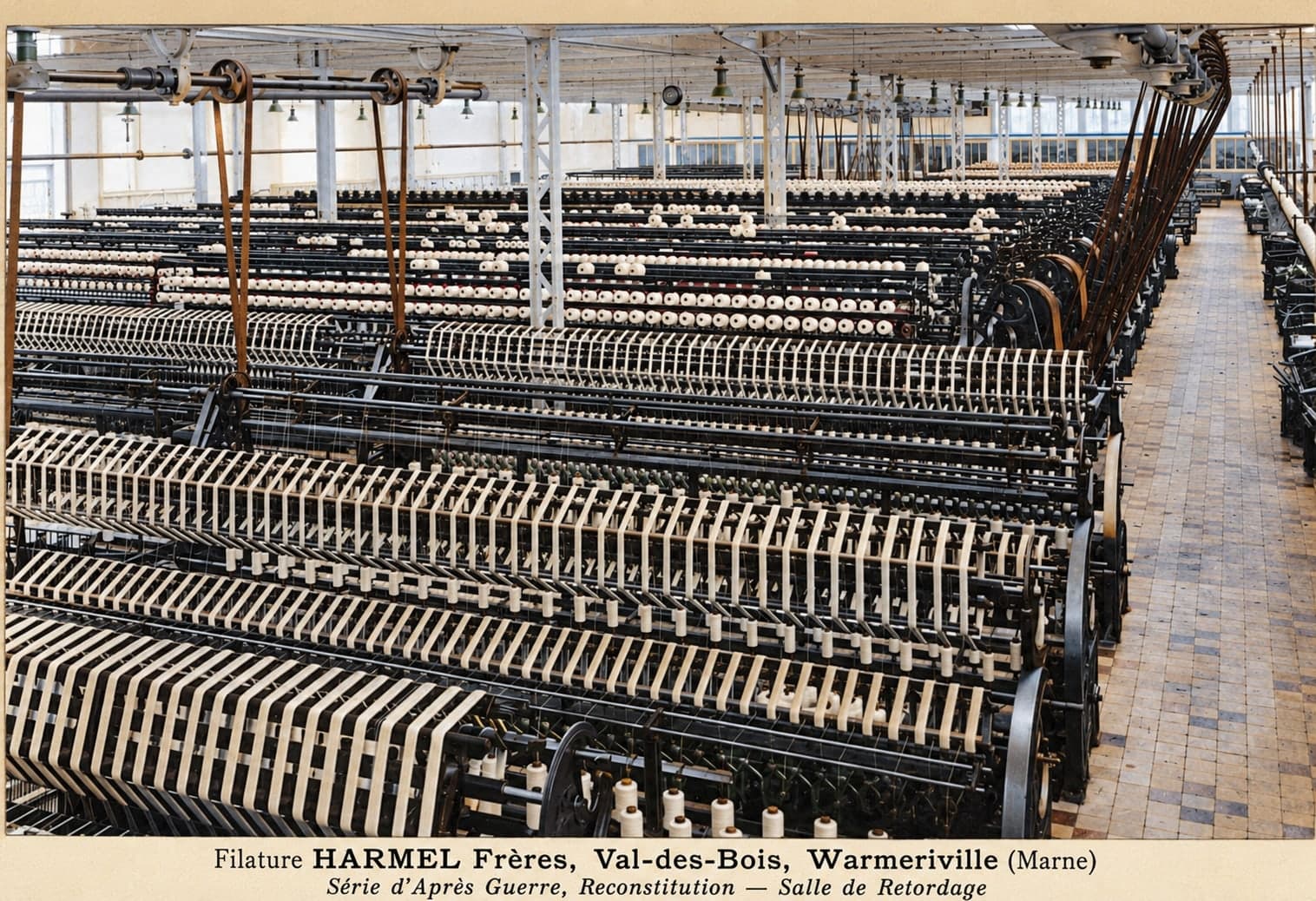
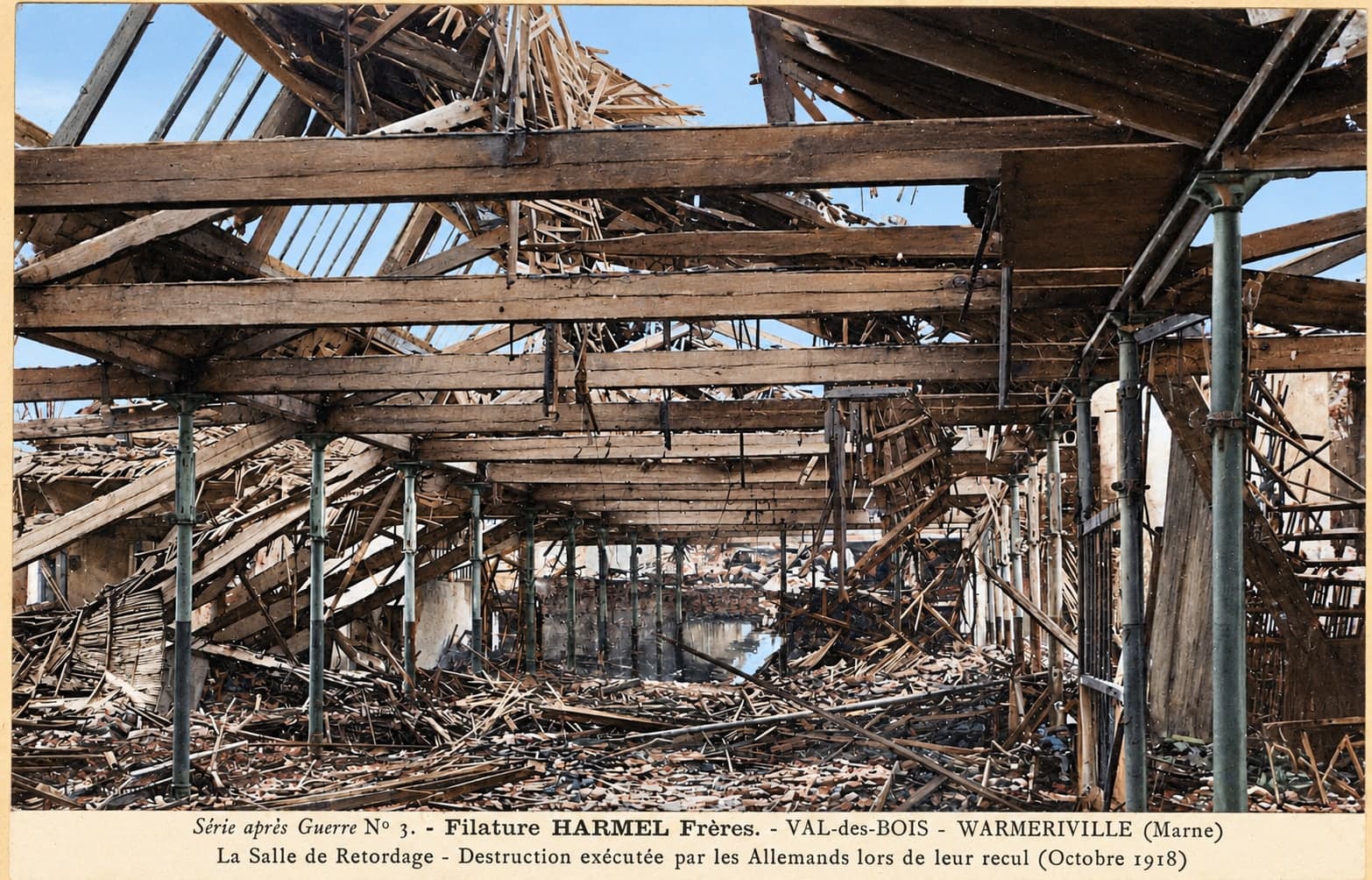
The same room, on two postcards published by Harmel frères: roof trusses collapsed after the German retreat of October 1918, then rows of new machines once the reconstruction was complete.
The Harmel family
From the blacksmith grandfather who became a spinner to Léon's children, four generations succeeded one another around the family business. Click a name to see that person's card.
The grandfather
The parents
married in 1824Léon and his family
married in 1852Léon was the fourth of eight children, five of whom survived: Léon himself, his elder sister Maria (Marie-Joséphine-Charlotte, 1825-1889), who married M. Guillot, his brothers Jules and Ernest, and his younger sister Virginie (1831-1869), Mme Collard. Jules married Euphémie Petit, and Ernest Louise Guillot. Albert, Jeanne-Gabrielle's brother, was both his cousin and his brother-in-law.
Léon Harmel
1829-1915
“The Good Father” of Val-des-Bois
Pierre Louis Prosper Léon Harmel, born on 17 February 1829 at La Neuville-lès-Wasigny and baptised on 8 March. He ran Val-des-Bois from 1854 onwards and made it a working community: factory council, family fund, schools, workers' pilgrimages to Rome. He died in Nice on 25 November 1915.
Source: Baptism record (AD Ardennes, 50J/NEUVILLE-LES-WASIGNY[LA] 2); Diocese of Reims
Léon's children
married in 1887Léon and Jeanne-Gabrielle had nine children. Gabriel, born on 13 September 1858, lived only three weeks; the other eight were living when their mother died in 1870. Marriages and grandchildren are given according to the family booklets of 1911 and 1915 and the civil registers.
Family tree drawn up from Léon's baptism record (Archives des Ardennes), Cousin-Henrat's Étude historique sur Warmeriville (Historical Study of Warmeriville, 1900), the Notice sur Jacques-Ernest Harmel (1913), the Souvenir de famille (Family Keepsake) and the account of the Good Father's last days (1915), Gabrielle's death announcement (1888), Émeric Saucourt-Harmel's biography (2025) and published family trees; entries marked “to be confirmed” still need to be checked against the civil registers.